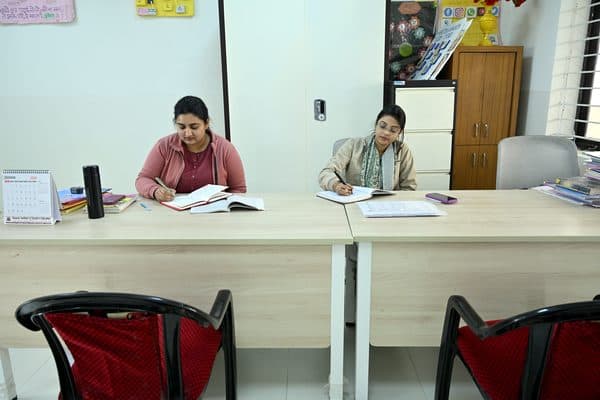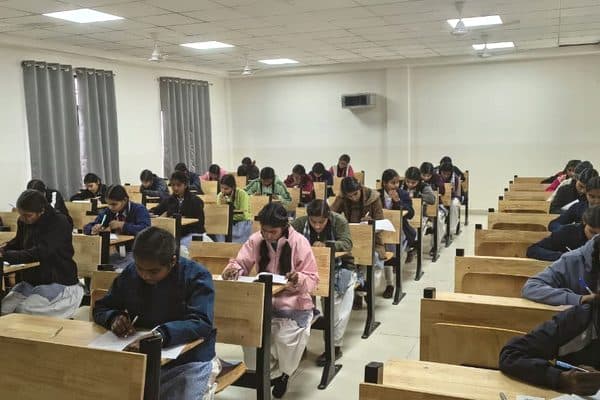
CTET and UPTET are the gatekeeping exams for a government teaching career in India. CTET is the central-level qualifier (required for CBSE schools, KVS, NVS, and most central-government roles). UPTET is the Uttar Pradesh state qualifier for Basic Education Board and SCERT roles. Most B.Ed / D.El.Ed candidates at BITE sit for both within 18 months of graduation. This post explains how BITE's curriculum integrates preparation, what the exam structure looks like in 2026, and how to prepare effectively.
CTET — structure in 2026
CTET has two papers:
- Paper I — for candidates aiming at classes 1–5 (primary). 150 multiple-choice questions across Child Development & Pedagogy, Language 1, Language 2, Mathematics, and Environmental Studies.
- Paper II — for candidates aiming at classes 6–8 (upper primary). Same 150 questions but with subject options — Mathematics & Science, OR Social Studies, OR the language papers.
Total duration: 2.5 hours. Qualifying score: 60% for general category (90/150), 55% for reserved categories.
CTET is held twice a year — typically January and July.
UPTET — structure in 2026
UPTET has the same two-paper structure (Paper I for primary, Paper II for upper primary). Question patterns closely follow CTET but with a UP-specific bent in the Environmental Studies and Social Science sections (UP geography, history, governance questions appear).
Qualifying score: 60% general, 55% reserved.
UPTET is usually held once a year.
How BITE integrates this into the curriculum
The B.Ed and D.El.Ed syllabi at BITE were designed (and periodically revised) with CTET / UPTET question patterns in mind. Specifically:
- Child Development & Pedagogy — covered in Year 1 across two courses (Psychology of Learning, Sociological Foundations). The CTET questions on learning theories, Piaget, Vygotsky, Gardner's multiple intelligences, classroom assessment — all of these appear in B.Ed coursework.
- Mathematics pedagogy (for primary levels) — covered in D.El.Ed's Mathematics Education course; B.Ed students taking Mathematics as a pedagogy subject cover CTET-relevant ground.
- Environmental Studies pedagogy — D.El.Ed Year 2 integrates EVS content with activity-based teaching, which directly maps to CTET EVS questions.
- Language teaching (English + Hindi) — both programmes have courses on language across the curriculum; CTET's language-comprehension questions overlap closely.
The practical consequence is that a BITE trainee who does well in their B.Ed / D.El.Ed internals is already 60–70% prepared for CTET. The gap is exam technique, not content.
Optional CTET / UPTET coaching module
In the final semester, BITE runs an optional coaching module specifically for CTET / UPTET. It covers:
- Full mock tests (typically 4 per week in the 6 weeks before the exam)
- Previous 5 years of CTET and UPTET papers
- Question-pattern analysis (which topics appear every year, which rotate)
- Time-management strategies (CTET is a high-question-count exam; speed matters)
- Test-taking psychology (handling difficult questions without losing pace)
Historical pass rates: ~78% of BITE B.Ed trainees (2024 cohort) cleared CTET on their first attempt after graduation.
Self-preparation tips
If you prefer to prepare independently: 1. Start 4 months before the exam date. Three months is often too tight; two months is definitely too tight. 2. Past papers first, textbooks second. Read 3 years of past papers to understand question style before touching prep books. 3. NCERT textbooks are non-negotiable — classes 6–10 NCERT books for the subject content sections (Mathematics, Science, Social Studies, EVS). 4. Focused prep books — Arihant, Pearson, and Oswaal publish CTET-specific prep books. Pick one, work it end-to-end. 5. Mock tests — at least one full-length mock per week in the final 6 weeks. 6. Join a study group — even an online one. Studying alone for 4 months burns out.
What to do if you don't clear on the first attempt
About 20–30% of first-time candidates don't clear. This is not a disaster. CTET has no attempt limit; the qualification is valid for 7 years (CTET) or lifetime (newer UPTET rules). Many excellent teachers cleared on their third or fourth attempt. Use the gap to strengthen specific weak sections.
After clearing: what happens next
A CTET / UPTET qualification is a necessary but not sufficient condition for government teaching. You also need to: 1. Clear a recruitment exam (UPPSC, UP Basic Education Board, KVS, NVS — each has a different process). 2. Appear in document verification. 3. Clear a short interview or demo teaching session. 4. Join after the merit list is published.
Timeline from CTET clearance to joining: typically 6–18 months depending on which recruitment cycle is active.
CTET and UPTET are the first door. A BITE B.Ed or D.El.Ed opens the door more confidently.